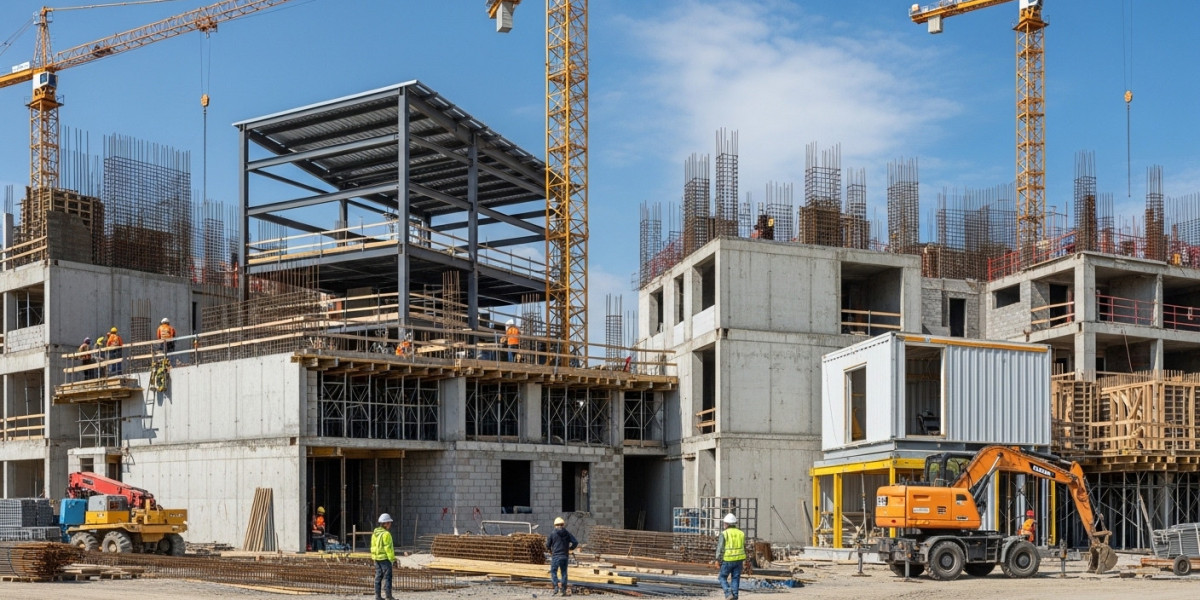
Construction projects today rely on several techniques that determine how efficiently, safely, and sustainably a structure is built. The five dominant construction types, which are traditional construction, prefabricated construction, modular construction, steel frame construction, and insulated concrete form (ICF) construction, have their own benefits based on the size of the project, budget, and the purpose of the construction.
In modern development planning, builders often collaborate with professional estimating services in USA to evaluate costs and project feasibility before choosing the appropriate construction method. The old methods of construction are appreciated due to their long-term standing and adaptability, whereas the new ones, like the modular and prefabricated buildings, are respected because of their quickness and accuracy. Steel frame and ICF methods focus on durability, efficiency, and strength.
1. Traditional Construction (Brick-and-Mortar Method)
Overview:
One of the largest and oldest known construction methods that is used all over the world is traditional construction, commonly referred to as brick-and-mortar construction. It is a combination of building the building in parts in the field by using bricks, concrete blocks, cement, sand, and steel.
How It Works:
In this technique, the groundwork is done first, then walls, floors, and roofs are constructed by using skilled people. The stages are accomplished one after the other, giving it the flexibility in design, but it may take more time to accomplish.
Advantages:
Durability: Brick and concrete structures are durable and can resist adverse weather.
Flexibility in Design: Architects are able to make changes in designs on-site.
Local Availability: Cement, bricks, steel, and other materials are readily available.
Disadvantages:
Time-Consuming: Construction by hand takes up more man-hours and time.
Weather Dependency: Rain or extreme weather can influence the progress of the work.
Increased Labor Costs: Skilled masons and workers are required, and this increases the cost of the projects.
Best For:
Housing, small business structures, and conventional constructions.
2. Prefabricated Construction
Overview:
Prefabricated (also known as prefab) construction is a method of construction where building components (such as walls, floors, and roofs) are built off-site in a regulated factory setting. These parts are then shipped and assembled on-site.
How It Works:
The 3D modeling and BIM (Building Information Modeling) technology are used to conclude the design of the building. The production of a constituent in parts is carried out in a factory and transported to the construction site.
Advantages:
Shorter Duration: On-site assembly is fast because large parts have been assembled.
Perpetual Quality: Factory production guarantees accuracy and minimization of defects.
Management Control: Manufacturing wastes are minimized.
Disadvantages:
Transportation Costs: The large areas are expensive to transport.
Limitations of Design: It has fewer customizations than traditional construction.
Needs Excellent Assembly Teams: On-site employees need to be trained to install correctly.
Best For:
Hotels, hospitals, offices, as well as housing developments, demand speed and consistency.
3. Modular Construction
Overview:
Prefabrication is more or less like modular construction. Rather than producing parts separately, complete 3D modules/units (such as rooms or sections) are constructed elsewhere and then assembled on-site.
How It Works:
Each of the modules is prefabricated in a facility that contains all the interiors, such as the walls, floors, electrical, and plumbing. The modules are brought on-site, whereby they are stacked or joined to create a whole structure.
Advantages:
Speed and Efficiency: Duration of construction is reduced by up to 50%.
High Quality: Modules that are manufactured in factories are more consistent and accurate.
Environmentally Friendly: This cuts waste on-site and environmental disturbance.
Flexibility: Later on, the modules may be moved around or expanded.
Disadvantages:
Transportation Problems: Huge modules have to be transported by special transport and handled with care.
Large Start-up Fee: Costs are high to establish factories and other equipment.
Little Customization: It is more difficult to change the design of modules after they are made.
Best For:
Schools, hospitals, residential housing, and tents.
4. Steel Frame Construction
Overview:
The construction of a steel frame is a skeleton structure of vertical columns and horizontal beams constructed out of structural steel. This is a very common method when dealing with high-rise structures, industrial structures, and bridges.
How It Works:
The metal elements are manufactured off-site and fitted on-site. The framework serves as a support system, which holds the walls, floors, and roofs. The structure is usually enclosed using concrete or glass panels.
Advantages:
Large Strength-to-Weight Ratio: Steel is capable of supporting a load of high load on a small amount of material.
Rapid Assembly: Steel prefabricated components save time on the site.
Design Versatility: Flexibility to expand span and the open/column-free space.
Pest-resistance: Natural calamity resistant, such as earthquakes.
Disadvantages:
Corrosion Risk: Steel should be coated or treated in order to avoid rust.
Increased Cost: The cost of steel is not constant, and it may increase the total cost.
Fire Resistance: Steel becomes weak in the presence of intense heat and requires an anti-temperature layer.
Best For:
Bridges, industrial buildings, skyscrapers, and warehouses.
5. Insulated Concrete Form (ICF) Building
Overview:
ICF is a recent type of building technique that involves reinforced concrete and insulation panels. It is famous for producing sustainable and energy-efficient buildings.
How It Works:
ICF involves the use of interlocking foam blocks or panels, which are stacked to create building walls. After positioning, concrete is then poured into the hollow forms to simplify concrete estimating and allowed to dry. The foam is a permanent insulation that forms a solid and thermally effective wall.
Advantages:
Good Insulation: Will save a lot of money in heating and cooling.
Soundproof and Fire-Resistant: More protection and comfort.
Strong and durable: The Concrete core has great structural strength.
Energy Efficiency: Achieves green building/sustainability.
Disadvantages:
Increased Material Cost: Foam blocks and specialised labour raise costs.
Lack of Design Flexibility: More difficult to adjust once the walls are installed.
Needs Labor: Labor is required to ensure proper installation that avoids air leakage or uneven pouring.
Best For:
Homes, basements, schools, and commercial buildings located in extreme climates consume less energy.
Conclusion
The selection of the appropriate method of construction is determined by the needs of the project, budget, schedule, and location. Though traditional construction still stands its ground with its familiarity and flexibility, modern methods of construction are becoming more popular in terms of speed, quality, and sustainability, such as modular, prefabricated, and ICF.
Incorporating a steel frame and modular construction is the most efficient and economical approach to structuring massive or time-sensitive projects. Nevertheless, ICF construction is one of the sustainable solutions to consider in the future when it comes to homeowners willing to be comfortable and save energy.
FAQs
What Is The Most Common Method Of Construction Today?
The most widespread is the traditional construction with the use of bricks and similar materials, which is still the most typical in the world because of its simplicity, durability, and availability of materials.
Which Construction Method Is The Fastest?
Modular construction is the fastest, as prebuilt modules are assembled quickly on-site, reducing overall project timelines by up to half.
What Is The Most Sustainable Construction Method?
Insulated Concrete Form (ICF) and prefabricated construction are among the most eco-friendly methods, as they reduce waste and improve energy efficiency.